Home / Why THE THREAD / Impact Stories

What changes when people, systems, and strategy align.

These stories show how institutions faced enrollment pressure, financial strain, leadership conflict, and stalled plans: the problem, the decisions, the people involved, and the evidence of what changed.

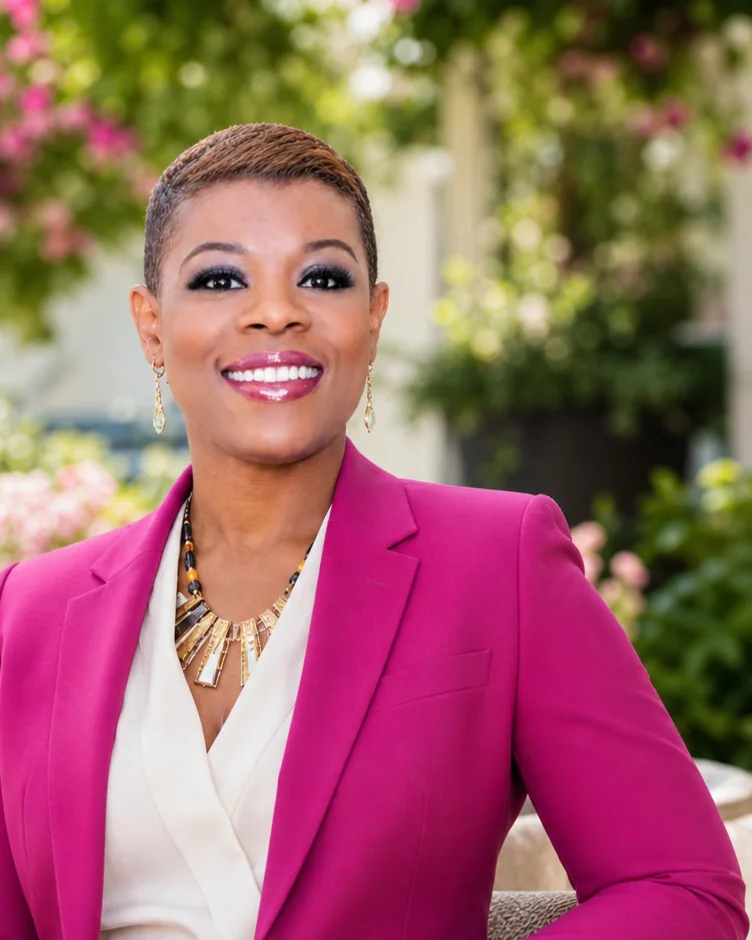
A leader presenting a connected strategy to colleagues
The problem we exist to solve

Explore the challenges institutions are working to solve.

When people, systems, and strategy are disconnected, the symptoms may appear as enrollment pressure, financial strain, leadership conflict, weak execution, or declining public confidence. Explore what changed when institutions addressed the underlying organizational conditions, not only the presenting problems.

Sector
Practice
What did the work

Institutional priority 1 of 5

Financial Sustainability & Institutional Vitality

“Our costs are rising, our resources are constrained, and the way we operate may not be financially sustainable.”

What leaders tell us

The strategic question. How can we strengthen institutional performance, diversify revenue, steward assets, and finance our future without compromising the mission?

Featured case · Pacifica Graduate Institute · Higher Education

When the Cost of Place Competes with the Future of the Mission

The organizational challenge

Pacifica Graduate Institute operated two campuses: the Ladera Lane campus in Santa Barbara, which it owns, and the Lambert Road campus in Carpinteria, which it leases. In March 2021, before Dr. Mattison’s appointment, the institution’s accreditor required a facilities master plan for long-term sustainability, including “determining the necessity of the Lambert campus considering strategic priorities.” For a small graduate institution, carrying a leased campus alongside an owned one ties up resources the mission needs elsewhere. The question had stayed open while other pressures mounted.

How the work was led

Rather than decide from the executive suite, the administration commissioned a Campus Utilization Study in 2023. A committee of faculty, staff, and administration representatives led it with external consultants, examining how the two campuses were actually used. The findings informed the Board of Trustees’ long-range planning. In January 2025, the Board announced that Pacifica would not renew the Lambert lease and would consolidate at the campus it owns, and a Campus Consolidation Committee of administration, faculty, and staff representatives was formed to oversee the transition.

What changed

Strategy
An inherited accreditation question became a Board decision grounded in evidence about how space served the mission.
People
Faculty and staff helped produce the evidence, rather than receiving a decision they had no part in.
Systems
A cross-functional committee now governs the transition, so the move does not rest on one office.

Evidence of results

After the initiating leader’s tenure

The consolidation is being carried out by the institution after Dr. Mattison’s tenure. Pacifica reports that the Lambert lease expires in April 2027, and its July 2026 update says all operations and on-campus programs will move to Ladera by the winter 2027 quarter, later than the fall 2026 start first announced. WSCUC approval of the main-campus relocation has not been independently verified: as of October 2026, WSCUC’s public record still lists Lambert as the main campus. The long-term financial outcome is not yet independently verified.

Related case studies

Capital strategy, campaign readiness, and financial stewardshipNet assets, recertification, and a fundraising objective, each labeled for what it is.

Pacifica’s institutional reporting shows net assets of about $5.7 million in 2021 and $8.8 million in 2024, a 2021–2024 trend rather than growth within a two-year period. A proposed $10 million fundraising strategy was set as a campaign objective; it is a goal, not funds raised.

  • Archival document, pending verification

    Net assets of about $5.7M (2021) and $8.8M (2024), from the 2023–24 Onward Together Institutional Impact Report.

  • Verified in a public source

    The institution completed a three-year recertification with the U.S. Department of Education, approved for the next five years, and a $20,000 contribution brought the Pacifica Promise Program to $27,000.

    Source: New Year message, January 2025 (opens in a new tab)

  • Institutionally reported

    $3.5 million in federal relief funds recovered within six months. Independent source not yet verified.

Extension and International Studies as a diversified learning enterpriseContinuing education as a second learning enterprise alongside degree programs.

Pacifica Extension and International Studies is the institution’s continuing-education arm, offering graduate certificates, microcredentials, continuing-education series, a membership program, and conferences, live online and on campus. In December 2024, it was placed under a new Vice President of Institutional Advancement and Lifelong Learning. Its financial contribution has not been independently verified.

Pacifica SOUL Promise and philanthropic infrastructureA ten-year access commitment with a public giving channel.

The Pacifica SOUL Promise is a ten-year program to make depth psychological education, research, and care accessible on the Central Coast, with scholarships for up to 1,500 individuals in low-income communities and five initiatives, including a planned community clinic at the Ladera campus. Donations are received through the Santa Barbara Foundation. The participant numbers are program goals, separate from the fundraising objective above.

Across sectors: NYC Department of Health and Mental Hygiene, Sansum Diabetes Research Institute, CommUnify Related practice: Organizational Transformation & Design

Institutional priority 2 of 5

Enrollment, Student Success & Academic Value

“We need to attract students, retain them, improve outcomes, and demonstrate that our educational offerings deliver value.”

What leaders tell us

The strategic question. How can we connect academic relevance, enrollment, student services, technology, affordability, and educational outcomes?

Featured case · Pacifica Graduate Institute · Higher Education

When Students Experience One Institution but Services Operate in Silos

The organizational challenge

Students move through one institution: admission, enrollment, financial aid, coursework, dissertation, and licensure. At Pacifica, as at many small graduate schools, the offices that support that journey had grown up separately. The first-100-days listening tour named learner experience and success as one of six institutional themes, and the 2021 accreditation letter had already asked for stronger support infrastructure for hybrid and online learners.

How the work was led

The administration made the learner journey an institutional priority, “Evolve learner experience and success,” one of six goal areas set in the Winter 2023 report. Enrollment and student services were brought into closer coordination, a structure formalized as the Office of Strategic Enrollment and Student Success in the December 2024 leadership redesign. Faculty and dissertation support were strengthened through a partnership with the National Center for Faculty Development and Diversity.

What changed

Systems
Support organized around the learner’s path. By 2025, accreditors cited a Care Line, a Buddy Program, the Office of Strategic Enrollment and Student Success, a Writing Resource Specialist, and library resources.
People
Dissertation writers gained structured support: 37 students joined a 12-week Dissertation Success Curriculum pilot.
Performance
New fall enrollment grew 14% in 2023. The outcome figures below are labeled by source.

Evidence of results

  • Verified in a public source

    14% increase in new fall student enrollment (Fall 2023). 218 degrees awarded in 2022–23 (the same report also cites 200 conferrals). 2022 licensure pass rates: 89% on the LMFT Law and Ethics exam and 80% on the LMFT Clinical exam; the report gives no comparison benchmark.

    Source: 2023 Annual Presidential Report (opens in a new tab)

  • Verified in a public source

    One-year student retention of 89%; 1,318 learners enrolled in 2023 (897 in degree programs, 421 in certificates); 746 admission applications in 2023.

    Source: 2024 Provost Prospectus (opens in a new tab)

  • Verified in a public source

    WSCUC commended “student support services including Care Line, Buddy Program, OSESS, Writing Resource Specialist, and Library Resources” (February 2025).

    Source: WSCUC reaffirmation letter, February 2025 (opens in a new tab)

  • Archival document, pending verification

    352 degrees awarded in 2023–24, 96% first-year doctoral retention, and a reported 100% three-year master’s completion measure, from the 2023–24 Onward Together Institutional Impact Report. Full licensure results, including areas below benchmark, will be added from that report once it is approved for publication.

What remained unfinished

The same 2025 letter required processes for tracking retention, graduation, licensure pass rates, and post-graduation debt, and for analyzing achievement gaps between student groups. These outcomes reflect the work of many offices and faculty; they are not attributed to one support office.

After the initiating leader’s tenure

Long-term outcome not yet independently verified.

Related case studies

Strategic enrollment managementEnrollment measured with the right population and period.

New fall student enrollment grew 14% in 2023 across the institution. Growth above 40% was reported separately for selected programs, the Doctor of Physical Therapy and Doctor of Clinical Health, and should not be read as institution-wide growth.

Online academic expansion and regulatory approvalsThe first fully online degree programs in the institution’s history.

Pacifica launched two fully online degree programs, the first in its nearly 50-year history: an online track of the M.A./Ph.D. in Jungian and Archetypal Studies and a new M.A./Ph.D. in Psychology, Religion, and Consciousness. The institution reported that WSCUC approved these efforts.

Faculty professional development and dissertation supportStructured support for faculty and doctoral writers.

Pacifica renewed its membership in the National Center for Faculty Development and Diversity; 85 community members joined, 52 of them students. The Dissertation Office ran a 12-week Dissertation Success Curriculum pilot with 37 students, and research with human participants moved to external IRB review through Cottage Health in March 2024.

Across sectors: County of Santa Barbara Related practice: Organizational Transformation & Design

Institutional priority 3 of 5

Governance, Institutional Trust & Accountability

“Our institution is experiencing conflict, distrust, executive turnover, governance problems, or recurring accreditation concerns.”

What leaders tell us

The strategic question. How can we restore effective governance, institutional confidence, academic continuity, and accountability while confronting difficult organizational patterns?

Featured case · Pacifica Graduate Institute · Higher Education

When Longstanding Faculty Grievances Reveal a Deeper Organizational Problem

The organizational challenge

In 2021, Pacifica’s accreditor asked the institution to examine faculty workload, equitable compensation, class size, and academic support against external benchmarks, and to strengthen shared governance. Faculty had set out their concerns in omnibus resolutions. By August 2022 the strain was public: the Santa Barbara Independent reported student protests over faculty dismissals, a faculty vote of no confidence in the provost, and complaints filed with the accreditor and the state. Dr. Mattison took office weeks later, in October 2022. In January 2023, the accreditor’s interim review asked the institution to “continue to urgently make progress on unresolved faculty concerns.”

How the work was led

The administration treated the grievances as a design problem, not a communications problem. The Winter 2023 report committed to “redesign the Office of the Provost through the implementation of key Omnibus Resolutions,” appointed an interim provost, and engaged the National Center for Faculty Development and Diversity and Stevens Strategy. The institution then completed its first Faculty and Staff Compensation and Workload Study, adopted a faculty rank and promotion policy, and put in place its first shared governance structure, with a Shared Governance Statement and a decision matrix defining the roles of the Board, executive leadership, faculty, staff, and students. In December 2024, a faculty member joined the Executive Leadership Team for the first time.

What changed

Systems
Decision rights written down: a shared governance structure and a decision matrix, rather than informal practice.
People
Faculty gained a rank and promotion pathway and a seat on the Executive Leadership Team.
Performance
Compensation was reviewed against the market and adjusted, and the accreditor formally recognized the progress.

Evidence of results

  • Verified in a public source

    The Board credited “Completing the first ever, Faculty and Staff Compensation and Workload Study” and “Executing our first Shared Governance Structure,” and “unanimously and wholeheartedly endorses President Mattison.”

    Source: Board of Trustees statement (opens in a new tab)

  • Verified in a public source

    WSCUC commendations (February 2025): “Progress in addressing the faculty omnibus resolution,” “Approval of faculty rank and promotion policy,” and “Review of staff compensation by position resulting in adjustments to meet market averages.”

    Source: WSCUC reaffirmation letter, February 2025 (opens in a new tab)

  • Verified in a public source

    Pacifica describes shared governance across the Board, executive leadership, faculty, staff, and students, with a decision matrix being finalized.

    Source: Shared governance at Pacifica (opens in a new tab)

  • Archival document, pending verification

    A $725,000 wage investment, documented in the 2022 Faculty Omnibus Resolutions Progress Report of July 22, 2024. The reporting period will be stated once the document is approved for publication.

What remained unfinished

The work was not finished. WSCUC reaffirmed accreditation for six years without a sanction, and required a progress report by November 1, 2025, on approving and implementing the faculty governance policy and structure and on revising the faculty handbook and evaluation procedures, with a special visit in fall 2027.

After the initiating leader’s tenure

Implementation of the faculty governance policy and handbook continues under the institution. Long-term outcome not yet independently verified.

Related case studies

Academic continuity during the 2022 institutional crisisStabilizing teaching and leadership after a public crisis.

Dr. Mattison took office in October 2022, weeks after faculty dismissals, student protests, and a no-confidence vote in the provost were reported publicly. An interim provost was appointed, and residential sessions returned to full on-campus attendance.

Accreditation and institutional effectivenessFrom required responses to a six-year reaffirmation.

The 2021 Commission letter required responses in six areas, without imposing a sanction. The January 2023 interim review commended progress on strategic planning and on diversity, equity, and inclusion. In February 2025, WSCUC reaffirmed accreditation for six years, with a progress report due November 2025 and a special visit in fall 2027.

Board relationships, campus communication, and institutional trustTrust rebuilt through participation, and named where it still needed work.

The Board of Trustees publicly and unanimously endorsed the president’s work. Monthly video updates to the community drew more than 500 views. In 2025, the accreditor still asked for consistent communication and effective processes during change, a reminder that trust is maintained, not declared.

Across sectors: County of Santa Barbara Related practice: Organizational Transformation & Design

Institutional priority 4 of 5

Leadership, Organizational Effectiveness & Transformation

“We have committed people and a strategic plan, but our leadership, structure, systems, and execution are disconnected.”

What leaders tell us

The strategic question. How can we identify recurring organizational patterns, align people and priorities, redesign decision processes, develop leadership capacity, and improve execution?

Featured case · Pacifica Graduate Institute · Higher Education

When Every Department Has Priorities but the Institution Lacks Shared Direction

The organizational challenge

After its founder era, Pacifica had committed people, an existing five-year plan, and many priorities, but no shared direction that the whole institution recognized. Listening sessions surfaced “a mix of passion and frustration around living our values,” and the observation that “we do not have research priorities.” The accreditor had asked for a strategic plan tied to mission, metrics, budget, and implementation.

How the work was led

The work began with listening. In the first 100 days, the administration met more than 500 people in over 30 listening sessions and 8 community events, guided by a simple principle: “People will champion what they help to create.” Six goal areas emerged. A four-stage strategic planning process with the consulting firm McIntyre-St.Clair followed: more than 25 documents reviewed, more than 70 interviews and focus groups, more than 35 steering committee participants, and 632 survey responses analyzed. The Board approved the plan, Onward Together 2030, in November 2023, with 4 goals and 32 strategies.

What changed

Strategy
One plan, four Board-approved goals, and 32 strategies the institution helped write.
Systems
An organizational redesign launched in 2023 led to a formal vice president structure and new offices in December 2024.
People
Hundreds of faculty, staff, students, and alumni contributed before any priority was set.

Evidence of results

What remained unfinished

Adopting a plan is not the same as completing it. In 2025, the accreditor asked the institution to set priorities, timelines, and action plans for its many in-progress projects, and to report Board approval of the strategic plan, values statement, and revised bylaws by November 2025.

After the initiating leader’s tenure

The plan runs to 2030 and its long-term objectives are carried by the institution. Progress against them is not yet independently verified.

Related case studies

People, culture, and belongingA dedicated office for people and culture.

An Office of People, Culture, and Belonging was established in the December 2024 leadership redesign, and accreditors commended a review of staff compensation by position that adjusted pay to market averages. The accreditor also asked for a belonging action plan and action on the 2024 employee climate survey.

Executive team and operating-model redesignA vice president structure and a clearer path to the leadership team.

In December 2024, Pacifica formalized a vice president structure, created offices for enrollment and student success, people and culture, general counsel and policy, finance and operations, academic affairs, strategic initiatives, and advancement, and placed a faculty member on the Executive Leadership Team for the first time. The memo describes a broader career lattice as still in progress.

Technology adoption and workflow modernizationOne integrated student information system.

Pacifica adopted Jenzabar One, a student information system that unifies student information, financial aid, and institutional operations on one platform, with rollout continuing into 2026. The institution also set a goal to digitize all grade and attendance reporting for the fall 2024 quarter.

Across sectors: County of Santa Barbara, CommUnify Related practice: Talent & Leadership Development

Institutional priority 5 of 5

Institutional Relevance, Partnerships & Public Impact

“Our mission and expertise are valuable, but we need stronger differentiation, partnerships, community relevance, alumni relationships, and long-term influence.”

What leaders tell us

The strategic question. How do we connect our institutional capabilities with new audiences, partners, funding, and measurable public contribution?

Featured case · Pacifica Graduate Institute · Higher Education

When Institutional Expertise Is Respected but Does Not Reach Enough People

The organizational challenge

Pacifica’s scholarship in depth psychology was respected, but academic programs, public programs, and outreach reached their audiences separately. The listening tour named brand identity and community and global partnerships among the institution’s six themes.

How the work was led

Journey Week, held September 27 to October 1, 2023, brought programming that usually ran on separate calendars into one shared institutional event: a Wellness Day, the BEAM Career Fair, and a weekend conference. Featured speakers included Dr. Thema Bryant and Dr. Jaiya John. The week had a measurable aim set in advance: a target for prospective-student applications.

What changed

Strategy
Reputation translated into reach, with a target set before the event.
Performance
More than 450 participants, and applications above target.

Evidence of results

What remained unfinished

Applications are not enrollments. The report does not say how many of the 44 applicants enrolled.

After the initiating leader’s tenure

Whether Journey Week continued after 2023 has not been independently verified.

Related case studies

Institutional relationships and shared stewardshipRelationships rebuilt in the community during the first 100 days.

In the first 100 days, the administration hosted 8 community events, met more than 300 regional leaders at a Chamber of Commerce event, and gathered ideas from more than 30 alumni.

Alumni ConnectionsAn alumni network that continues today.

Pacifica’s Alumni Connections program continues, organized around four pillars (Connect, Cultivate, Celebrate, Contribute), with monthly Wisdom Well gatherings, Careers in Depth sessions, and the Abakanowicz Community Praxis Fellowship. When the program took its current form has not been independently verified.

Regional and healthcare partnershipsPartnerships that extend research and care in the region.

Since March 2024, research with human participants has been reviewed by an external IRB through Cottage Health, which also offers human-subjects training to faculty and students. The SOUL Promise plans a community clinic at the Ladera campus.

International engagement and archival stewardshipLearning offered beyond the campus.

Pacifica Extension and International Studies offers programs live online and on campus. A summary of international engagement and archival stewardship will be added once the supporting archival documents are verified and approved for publication.

Across sectors: Newark Alliance, Sansum Diabetes Research Institute, NYC Department of Health and Mental Hygiene Related practice: Organizational Transformation & Design

The executive record behind the cases

Six institutions, across sectors.

The five priorities above draw on six institutions in higher education, government, human services, public health, workforce development, and research. Each story keeps its own chronology, role, and sources. These were executive roles held by Dr. Mattison before she founded THE THREAD; THE THREAD, LLC did not perform this historical work as a contractor.

Higher Education

Pacifica Graduate Institute

President and CEO, 2022–2025

  • 6 yearsWSCUC reaffirmation (2025), with progress reporting and a special visit required
  • 14%Growth in new fall enrollment, institution-wide (2023)
  • 54%Growth in net assets, 2021 to 2024
  • 15State authorizations to serve students (institutionally reported)
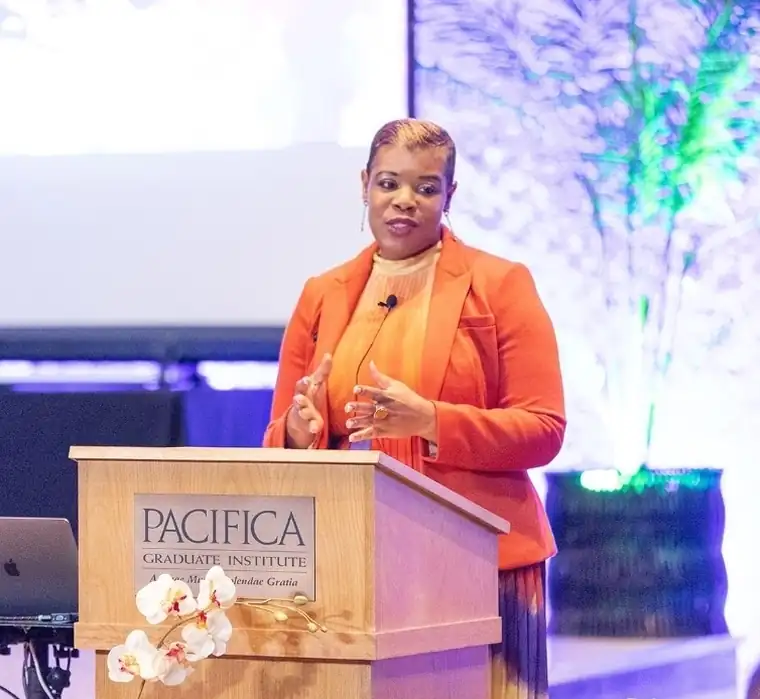
Dr. Leonie H. Mattison speaking as President and CEO of Pacifica Graduate Institute
Dr. Leonie H. Mattison, President and CEO, Pacifica Graduate Institute

The challenge

An institution in transition: a post-founder identity shift, a post-COVID enrollment decline, fractured governance, and an approaching reaffirmation review.

What this means for your organization

When an institution faces a leadership transition, a governance reset, or a high-stakes review, the work begins by aligning governance, strategy, and the people who carry them.

Related practice: Organizational Transformation and Design → · Talent and Leadership Development →

“The Board unanimously and wholeheartedly endorses President Mattison and the exemplary work she has done for PGI.”

Pacifica Graduate Institute Board of Trustees

5 case studies inside this story. The five featured cases above give the full account.

  1. 01

    Shared governance, built for the first time

    Shared governance

    Led a governance redesign that established the institution’s first shared governance structure, recognized in the Board of Trustees’ public statement, and a faculty rank and promotion policy that WSCUC commended in 2025. Read the full case

    Source: Shared governance at Pacifica ↗ · Board of Trustees statement ↗

  2. 02

    A strategy the whole institution could carry

    Shared governanceImproved workflow

    Launched the Onward Together 2030 Strategic Plan, approved by the Board in November 2023 with 4 goals and 32 strategies. Read the full case

    Source: 2022–2023 Annual Presidential Report ↗

  3. 03

    Access extended through technology

    Technology

    Launched WSCUC-approved fully online degree programs and certificates, including two fully online Ph.D. programs, extending access beyond the campus.

    Source: Online Ph.D. programs announcement ↗

  4. 04

    A partnership to grow the mental health workforce

    Partnerships

    Launched the Pacifica SOUL Promise, a ten-year program with a goal of scholarships for up to 1,500 individuals in low-income communities. A proposed $10M fundraising strategy was set as a campaign objective, not funds raised.

    Source: Pacifica SOUL Promise, Santa Barbara Foundation (opens in a new tab) · Pacifica Promise announcement, December 20, 2024 (opens in a new tab)

  5. 05

    Financial stability restored

    Improved workflow

    Net assets grew from about $5.7M in 2021 to $8.8M in 2024, a 2021–2024 institutional trend (institutionally reported). The recovery of $3.5M in federal relief funds is institutionally reported and pending independent verification.

Government

County of Santa Barbara and the County Employees’ University

Chief of Organizational and Talent Development

  • 4,600Employees supported by technology-enabled workforce systems
  • 23Departments connected to shared digital learning
  • 300+Internal job placements
  • 200+Employees heard in the listening tour

The challenge

A county workforce recovering from disaster, with a stalled strategic plan, low morale, and outdated civil service systems hindering recruitment and retention. An appreciative inquiry listening tour with more than 200 employees shaped what came next.

What this means for your organization

When a workforce is stretched and the strategy needs new capability, development has to be built into the system, with real pathways for people to grow.

Related practice: Talent and Leadership Development → · Organizational Transformation and Design →

“Leonie ensures that the workforce is kept in the know at all times...she is creative, a strong communicator and collaborator... I shared with my department how fun and welcoming she made it for the new employees. Good job!”

Mona Miyasato, County Executive Officer, County of Santa Barbara

5 case studies inside this story. The five featured cases above give the full account.

  1. 01

    The County Employees’ University, reimagined

    PartnershipsTechnology

    Reimagined the County Employees’ University as a regional engine for workforce development, partnering with California State University, Northridge, a WSCUC-accredited university, to give County employees a pathway to undergraduate and graduate degrees, and connecting 23 departments to shared digital learning.

  2. 02

    Passport to Public Service

    PartnershipsImproved workflow

    Launched Passport to Public Service with Santa Barbara City College through Adult Education Block Grant funding: monthly workshops that prepare residents to apply for, enter, and advance in County careers. The first workshop drew about 100 applicants.

    Source: Santa Barbara Independent, 2018 ↗

  3. 03

    The JOIN Equity Framework

    Shared governance

    Developed the JOIN Equity Framework, a shared, County-wide framework for workforce equity that departments could apply together.

  4. 04

    Renew ’22

    Improved workflowShared governance

    Advanced Renew ’22, the County’s organizational transformation initiative to re-balance resources, re-design work processes, respond to residents with quality services, and retain high-performing employees and develop leaders, including organizational and talent development reporting to County leadership.

    Source: County of Santa Barbara: Renew ↗

  5. 05

    SB Innovate

    Improved workflowTechnology

    Supported InnovateSBC (SB Innovate), the County’s process improvement and innovation training program, equipping employees at every level with tools to redesign their own work. Civil service rules, job classifications, and remote work frameworks were modernized alongside it.

    Source: County of Santa Barbara: InnovateSBC ↗

Nonprofit and Human Services

CommUnify

Chief Operating Officer

  • 24Sites
  • 16Core programs
  • 360+Employees
  • $398KFederal Family Self-Sufficiency grant

The challenge

A countywide community action agency facing surging demand during COVID-19, with siloed departments and outdated systems.

What this means for your organization

When demand rises faster than your systems can carry it, shared intake, onboarding, leadership development, and continuity planning protect both the service and the staff.

Related practice: Organizational Transformation and Design → · Talent and Leadership Development →

“Dr. Lee is a proven transformational leader who engages staff with a particular emphasis on communication, process improvement, organizational culture and breaking down departmental silos. Her thoughtful, intentional approach and ability to engage leaders at all levels and her focus on staff development and creating a learning culture has elevated our organization’s credibility on a statewide level.”

Patricia Keelan, CEO, CommUnify

5 case studies inside this story. The five featured cases above give the full account.

  1. 01

    Community Action Virtual Onboarding (CAVO)

    TechnologyPartnershipsImproved workflow

    Designed CAVO with the California Community Action Partnership Association (CalCAPA): a three-touchpoint virtual onboarding experience for employees, volunteers, board members, clients, and partners, built on four pillars: People First, Ignite Culture, Inspire Learning, and Show Impact.

    Source: CAVO ↗

  2. 02

    A Learning Academy for every role

    Partnerships

    Launched a Learning Academy for leadership development in partnership with Santa Barbara City College.

    Source: CommUnify Learning Academy ↗

  3. 03

    One front door for families

    TechnologyImproved workflow

    Advanced a universal screening and intake system across sites.

  4. 04

    Family Self-Sufficiency

    Partnerships

    Served as principal investigator for a $398,000 federal Family Self-Sufficiency grant.

  5. 05

    Continuity under crisis

    Shared governance

    Led the Emergency Response Taskforce and continuity-of-operations planning through the pandemic.

Public Health

NYC Department of Health and Mental Hygiene

Senior Grants Administrator

  • $20M→$65MGrant portfolio she managed
  • 1,000Jobs retained
  • 8.4MNew Yorkers served by CPPW

The challenge

One of the largest public health agencies in the world, working to address chronic disease and health disparities through a complex city, federal, and philanthropic funding portfolio.

What this means for your organization

When the funding is complex and the mission is large, fiscal systems, partnerships, and governance have to be designed for scale and accountability.

Related practice: Organizational Transformation and Design →

4 case studies inside this story

  1. 01

    CPPW: obesity prevention at city scale

    Partnerships

    Supported grants administration for New York City’s CDC-funded Communities Putting Prevention to Work (CPPW) initiative (2010), whose obesity work included water jets in 229 schools reaching more than 221,000 students, nutrition standards for city agencies, and Move-to-Improve, which trained 2,000 teachers.

    Source: CDC: CPPW New York City profile ↗

  2. 02

    Community Transformation Grant

    PartnershipsShared governance

    Supported New York City’s CDC Community Transformation Grant (CTG), awarded to the Fund for Public Health in New York at $8,391,881 a year in fiscal years 2011 and 2012, building multi-sector partnerships for chronic disease prevention.

    Source: CDC: CTG awards ↗

  3. 03

    Fiscal functions moved to a nonprofit partner

    Shared governanceImproved workflow

    Helped transition fiscal functions to the Fund for Public Health in New York, the nonprofit partner that provides fiscal and administrative management for the department.

    Source: Fund for Public Health in NYC ↗

  4. 04

    Grant systems built for scale

    TechnologyImproved workflow

    Modernized grant management and compliance systems as part of a systemwide transformation that grew the grant portfolio she managed from $20M to $65M and retained 1,000 jobs.

Workforce and Economic Development

Newark Alliance

Workforce innovation and regional economic development

  • 942Residents moved through training
  • 212Residents placed into jobs
  • $5.1MWIRED initiative funding

The challenge

The Great Recession: rising unemployment, and a regional economy that needed residents prepared for the jobs still growing.

What this means for your organization

When you need a workforce ready for what is next, training has to be tied to real jobs, real employers, and measurable placement.

Related practice: Talent and Leadership Development →

2 case studies inside this story

  1. 01

    WIRED: a regional partnership

    Partnerships

    Supported the federally funded Workforce Innovation in Regional Economic Development (WIRED) initiative, connecting education, training, and employers across the region.

    Source: Rutgers: federal grant supports education and training ↗

  2. 02

    From training to jobs

    Improved workflow

    Directed regional workforce innovation and economic development during the Great Recession, moving 942 residents through training and 212 into jobs.

Research and Health

Sansum Diabetes Research Institute

Director of Clinical Research Operations and Major Grants

  • $1.25MMil Familias grant funding
  • 1,000Latino families Mil Familias aims to enroll
  • 9Clinical sites in the NIH artificial pancreas trials

The challenge

A research institute growing its clinical trials portfolio, industry partnerships, and community programs at the same time.

What this means for your organization

When research, partnerships, and revenue have to grow together, operations and grant strategy must be designed as one system.

Related practice: Organizational Transformation and Design →

“Leonie and I started to work together just after I joined Sansum Diabetes Research Institute in Spring 2014. I was impressed by how well Leonie led the Research Operations and Major Grant activities, especially in helping to establish the Mil Familias program. She was very effective in generating revenue through industry-sponsored trials and clinical contracts, and in building relationships with higher education, nonprofits, and pharmaceutical companies. She clearly has a passion for helping others succeed.”

David Kerr, MD, Sansum Diabetes Research Institute

4 case studies inside this story

  1. 01

    Mil Familias

    Partnerships

    Helped establish Mil Familias, which aims to enroll 1,000 Latino families living with type 2 diabetes, securing $1.25M in grant funding with support from Eli Lilly.

    Source: Beyond Type 1: Mil Familias ↗ · Lilly announcement ↗

  2. 02

    Harvard and the artificial pancreas

    PartnershipsTechnology

    Supported Sansum’s role as one of nine clinical sites in NIH-funded long-term artificial pancreas trials led by Harvard engineering researchers.

    Source: Harvard Gazette, 2016 ↗

  3. 03

    Abbott and sensor-based glucose monitoring

    Technology

    Supported an Abbott investigational device study of the FreeStyle Libre sensor-based glucose monitoring system.

    Source: FDA announcement ↗

  4. 04

    Clinical trial contracts

    Improved workflowPartnerships

    Led research operations and major grant activities, generating revenue through industry-sponsored trials and clinical contracts, and building relationships with higher education, nonprofits, and pharmaceutical companies.

Exhibit 2 The scale of change

Before and after, drawn to scale

Three results from the stories above, each measured from zero so the change is shown at its true size. Pacifica net assets are institutionally reported for 2021 and 2024; the Newark bars show residents trained and the subset placed into jobs, not a before-and-after series.

Grant portfolio managedNYC Department of Health and Mental Hygiene
BeforeBefore: $20M$20MAfterAfter: $65M$65M
Net assetsPacifica Graduate Institute, 2021 and 2024 (institutionally reported)
20212021: $5.7M$5.7M20242024: $8.8M$8.8M
From training to jobsNewark Alliance, during the Great Recession
TrainedTrained: 942942Placed in jobsPlaced in jobs: 212212
Current advisory engagements

THE THREAD is currently providing advisory support to four institutions.

Client names are kept confidential.

  • 2Community colleges
  • 1Public university
  • 1Private university
What makes the work different

Six reasons leaders choose THE THREAD

Diagnosing underlying organizational patterns

We look beneath the presenting problem, whether enrollment, finances, or conflict, to the inherited patterns that keep producing it, as the governance and strategy cases show.

Experience leading from the executive seat

Our founder has served as president and CEO, chief operating officer, and chief transformation officer, so recommendations account for boards, budgets, accreditors, and the people who carry the work.

Integration of people, systems, and strategy

Structure, talent, data, and technology are designed together, because a new strategy fails when decision rights, roles, and systems stay the same.

Disciplined organizational and talent development

Listening, evidence review, and participation come before recommendations, and leadership capacity is built alongside the new design.

Evidence-led implementation and technology adoption

Baselines, targets, and named owners are set at the start, and technology is adopted to support redesigned work rather than to replace thinking about it.

Capability that remains with the client

Every engagement is designed to leave governance structures, skills, and measures the institution can sustain after we leave.

In their words

What colleagues say

“Dr. Lee is a proven transformational leader who engages staff with a particular emphasis on communication, process improvement, organizational culture and breaking down departmental silos. Her thoughtful, intentional approach and ability to engage leaders at all levels and her focus on staff development and creating a learning culture has elevated our organization’s credibility on a statewide level.”

Patricia Keelan, CEO, CommUnify

“Leonie ensures that the workforce is kept in the know at all times...she is creative, a strong communicator and collaborator... I shared with my department how fun and welcoming she made it for the new employees. Good job!”

Mona Miyasato, County Executive Officer, County of Santa Barbara

“Leonie and I started to work together just after I joined Sansum Diabetes Research Institute in Spring 2014. I was impressed by how well Leonie led the Research Operations and Major Grant activities, especially in helping to establish the Mil Familias program. She was very effective in generating revenue through industry-sponsored trials and clinical contracts, and in building relationships with higher education, nonprofits, and pharmaceutical companies. She clearly has a passion for helping others succeed.”

David Kerr, MD, Sansum Diabetes Research Institute

“Thank you so much! I knew you’d be able to run with this and make it more wonderful. I appreciate your synthesizing skills and your ability to anticipate our organization’s unspoken needs. You have great eagle eyes!”

María Elena De Guevara, Director of Human Resources
About the evidence How to read these stories, and what each label means

These stories draw on Dr. Leonie H. Mattison’s historical executive leadership and organizational transformation work, alongside the contributions of boards, executive teams, faculty, staff, and institutional partners. They are not represented as consulting engagements contracted to THE THREAD, LLC. THE THREAD’s contemporary services draw on this experience and its subsequently developed professional methods.

  • “We” in the Pacifica accounts refers to the administration and its collaborators.
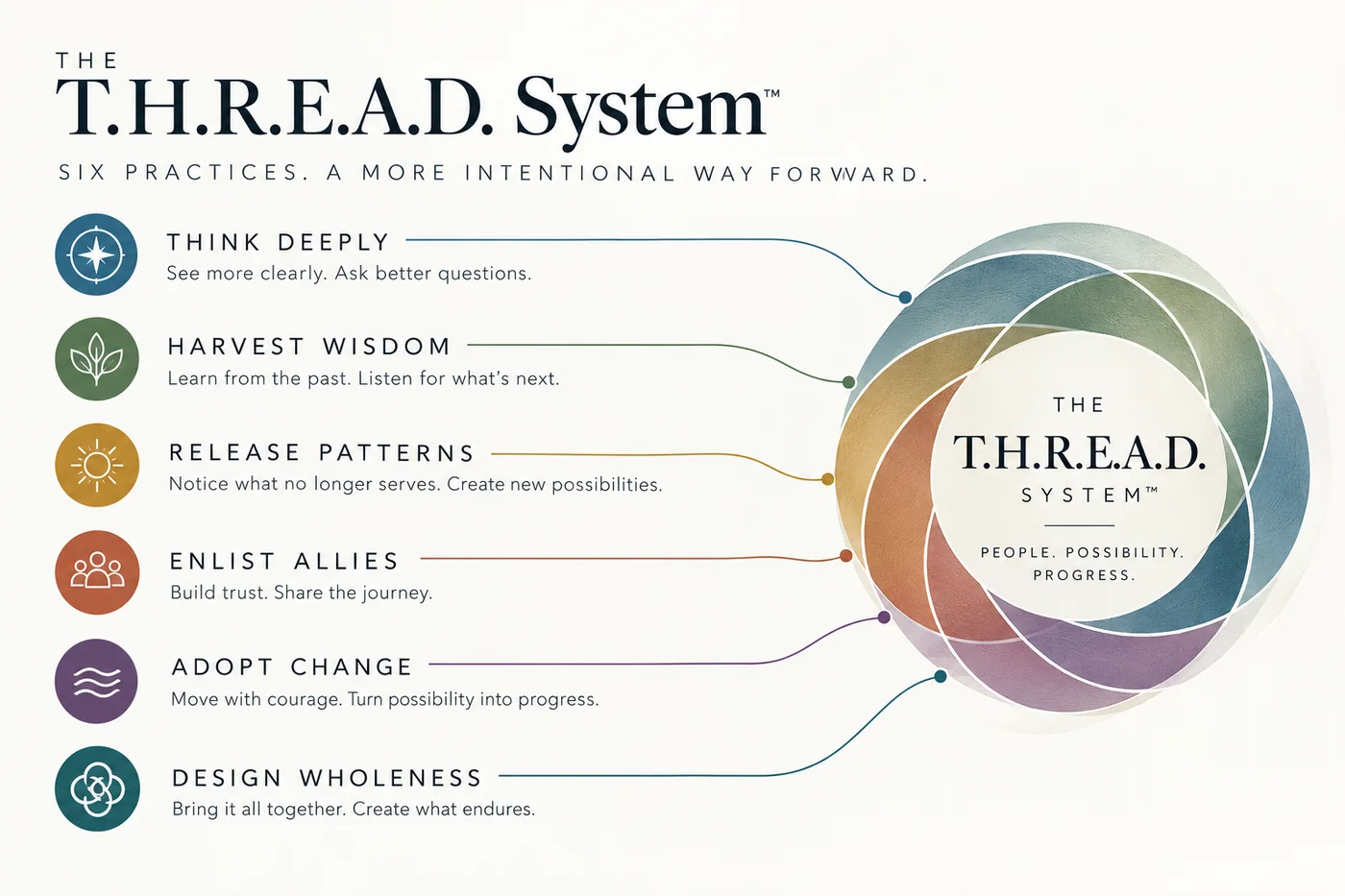
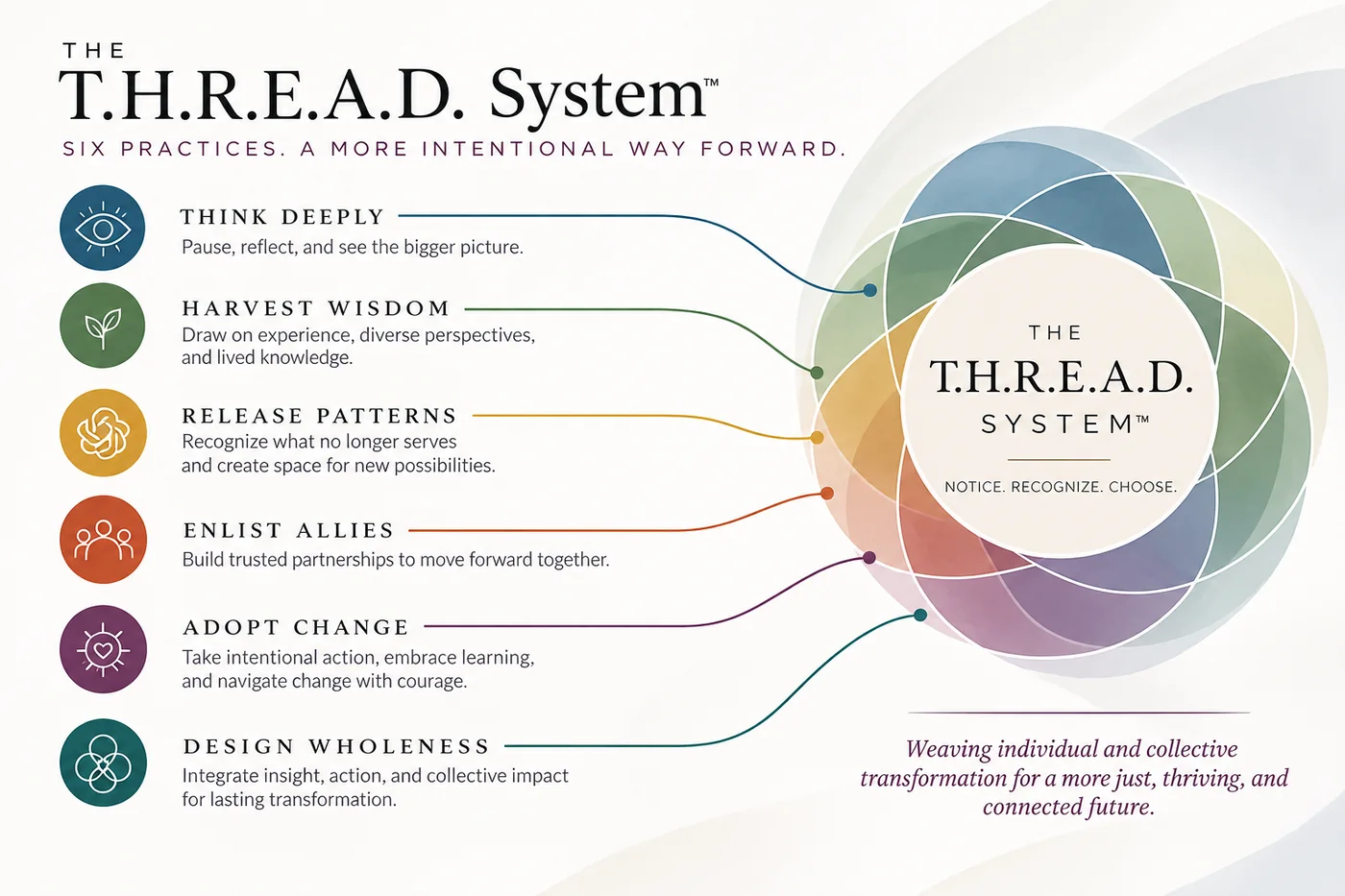
  • The current T.H.R.E.A.D. System™ is a professional framework informed by Dr. Mattison’s long-standing transformation work. It was not deployed at these institutions as a named consulting product.
  • Organizational pattern analysis here is an evidence-informed retrospective interpretation, not a clinical diagnosis.
  • Outcomes after a leader’s tenure are attributed to the institutions and teams responsible for continuing the work.

Verified in a public source the figure or fact appears in the linked source. Institutionally reported the institution or the founder’s records report it; an independent public source has not been verified. Archival document, pending verification from an internal report not yet approved for publication.

Next step

Discuss Your Organization’s Challenge

Whether your institution is confronting financial pressure, stalled strategy, leadership transition, workforce challenges, or the demands of a changing operating model, the work begins with understanding what’s producing the current results.