What we collect
When you submit a form or complete the Leadership Self-Reflection or the Institutional Coherence Index, we collect only what you provide: your name, email, title, organization, country, and your answers. Nothing more. The THREAD Check-In™ collects less, as described below.
The THREAD Check-In™
Starting is open. You can read the introduction and complete the five opening reflections without giving us any contact information.
What we collect, and when. After you write your reflection, choose a name for your moment, and confirm the reflection, the Check-In asks for your first name and email address. Both are required to continue to the practice questions and your THREAD Profile. When you select Continue, we receive four things: your first name, your email address, whether you checked the optional mailing-list box, and a note that the information came from the Check-In.
Why we ask. Your first name personalizes your experience on screen and in your PDF. We use your email address to keep a record of who has taken the Check-In during this pilot, and to contact you only about the Check-In itself, for example if we find an error that affects results. We do not use it to send you your results: your complete THREAD Profile appears on screen, and you can download it as a PDF.
What we do not receive. Your written reflections, the areas of life and values you select, the name you give your moment, your answers to the practice questions, your practice profile, and the pattern, practice, and exercise suggested to you are created in your browser and are not sent to us. Your first name and email are not sent together with any of them. No AI service is used to create your results.
Marketing is a separate choice. Giving your email to continue the Check-In does not subscribe you to anything. You join our mailing list only if you check the box, which is never checked for you, and you can unsubscribe at any time.
What stays on your device. While you work, your answers, including the first name and email you enter, are held in your browser for that tab only. They are removed when you close the tab or select “Clear my answers.” If you choose “Keep it on this device,” a short summary (your moment’s name, the date, your first name, your practice choices, the suggested pattern and exercise, your focus, and what you hope for, but not your full reflections) is saved in that browser so you can return to it later. Remove it with “Remove from this device” on the Check-In page or by clearing your browser data. If you choose “Download my moment file,” the same summary is saved as a file on your device. Your PDF is created on your device and is not sent to us.
Clearing your browser does not delete what you sent us. “Clear my answers” and clearing your browser data remove information from your device only. To delete the first name and email you gave us, email leoniemattison@thethreadllc.com.
Optional feedback. At the end, you may send feedback. Before anything is sent, the Check-In shows exactly what will be sent: your answers to the feedback questions, any note you write, and general information about your results, such as your perspective, the practice and exercise suggested, and whether you confirmed the reflection. Feedback does not include your name, email, or reflections, and it is sent only if you check the consent box.
Who processes it. Your first name, email, mailing-list choice, and any feedback are sent through a Google Apps Script form handler and stored in Google Sheets, a Google service. The Check-In page loads no analytics, advertising, or AI services. Like all websites, our hosting provider, Bluehost, receives standard technical information such as your IP address and browser type when you load a page.
Why we collect it
To create and send your report, to respond to your inquiry or follow up if you ask us to, and, in anonymized form, to advance research on institutional coherence. If you opt in, we also share occasional insights. We never sell your information, and we share it only with the service providers named in this notice, who store or deliver it for us.
Where it is stored
Securely in Google tools, including Google Sheets, accessible only to Dr. Leonie H. Mattison and associates who have signed a confidentiality agreement. A notification of each submission is sent to our team, and assessment reports are emailed to the address you provide.
How research use works
With your consent, responses may be combined with others, with names, emails, and organizations removed, to study patterns across institutions. Research is done on a separate, de-identified copy of the data. No individual or institution is ever identified in anything we publish, and we never report results for groups smaller than five.
If your institution engages us
In a Coherence Diagnostic, individual responses are never shared with your employer. The institution receives only combined results, and no group smaller than five is reported separately.
How long we keep it
Identifiable information is deleted or anonymized after three years. This includes the first name and email given in The THREAD Check-In™. Check-In feedback does not include your name or email.
Retakes
Retake the Index over time to compare how your perception of institutional coherence is shifting and identify questions worth examining more deeply. You can take it once every 24 hours. Each attempt is saved separately. If you complete the full Index after your snapshot, it is added to the same record. The full Index is available by invitation, through a private link or access code.
How we protect submissions
Our forms use Google reCAPTCHA and automated checks to block spam and misuse, and we limit how many report emails any address can receive each day. The THREAD Check-In™ page does not load reCAPTCHA or any other third-party script. Use of reCAPTCHA is subject to Google’s Privacy Policy and Terms of Service.
Your choices
You can request a copy of your information, ask us to correct it, unsubscribe, or ask us to delete it at any time by emailing leoniemattison@thethreadllc.com. This includes the first name and email you gave in the Check-In. We will respond within 30 days.
Contact
The Thread, LLC · leoniemattison@thethreadllc.com
Last updated October 10, 2026.

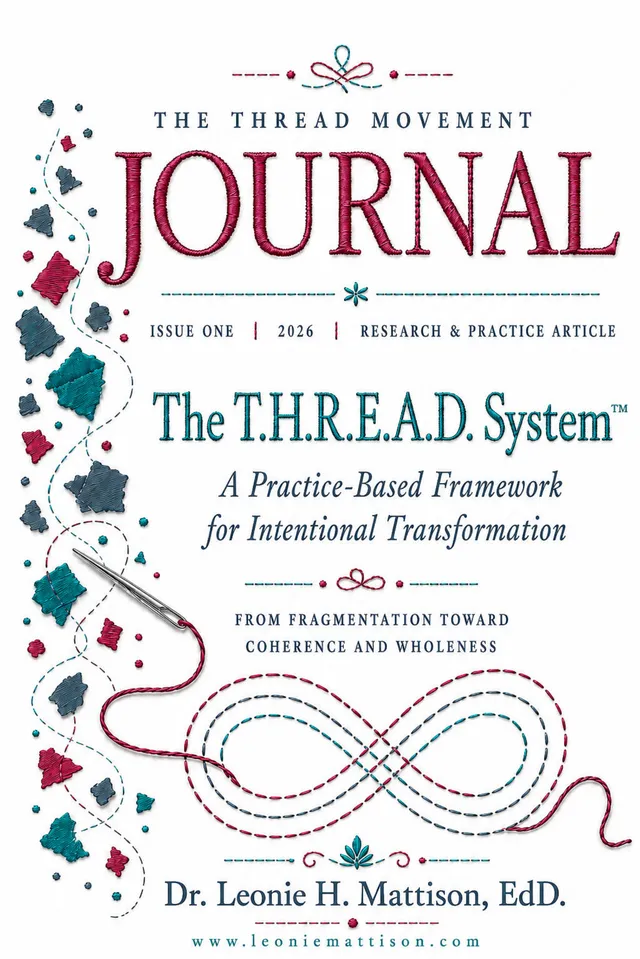














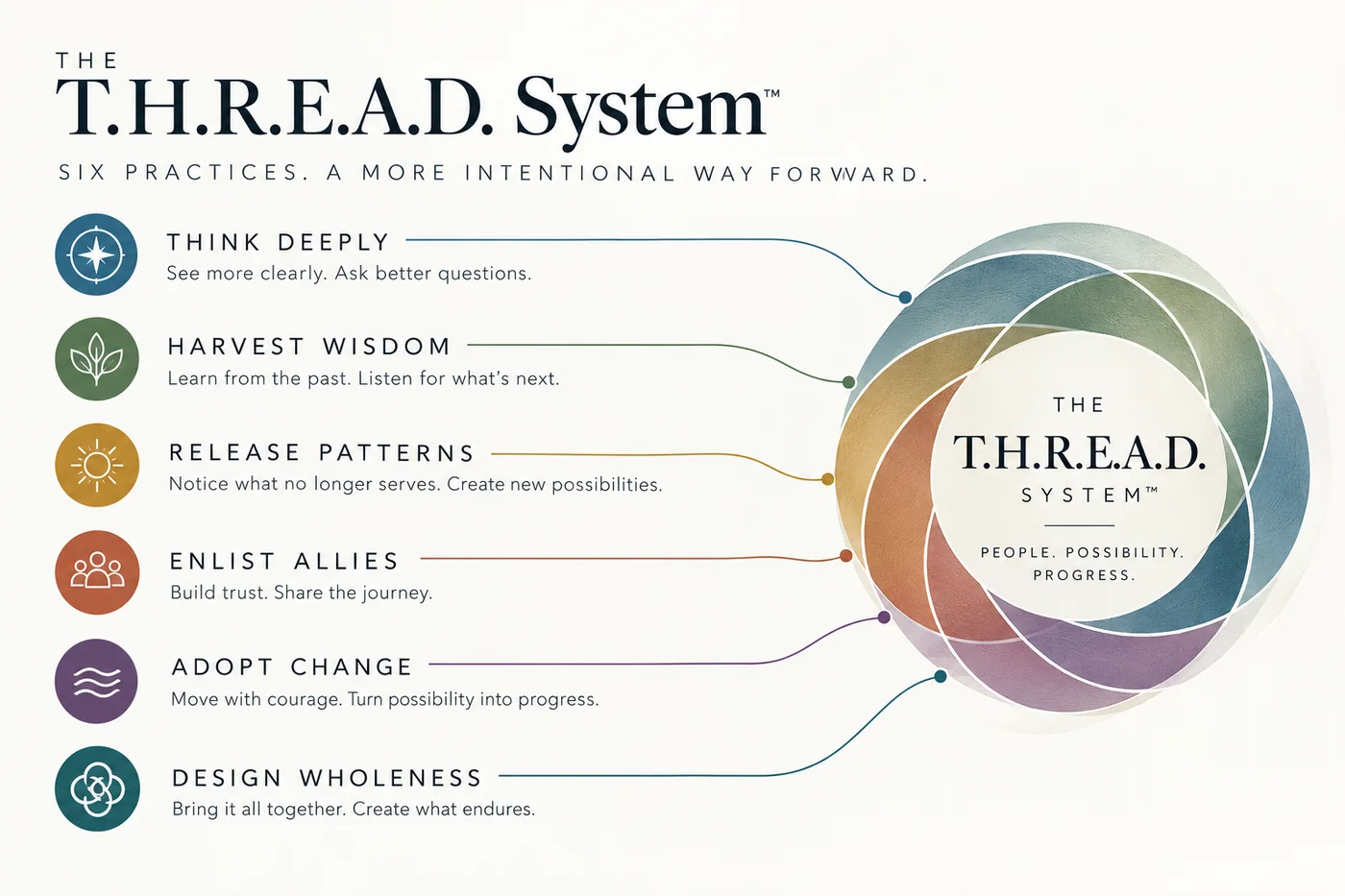
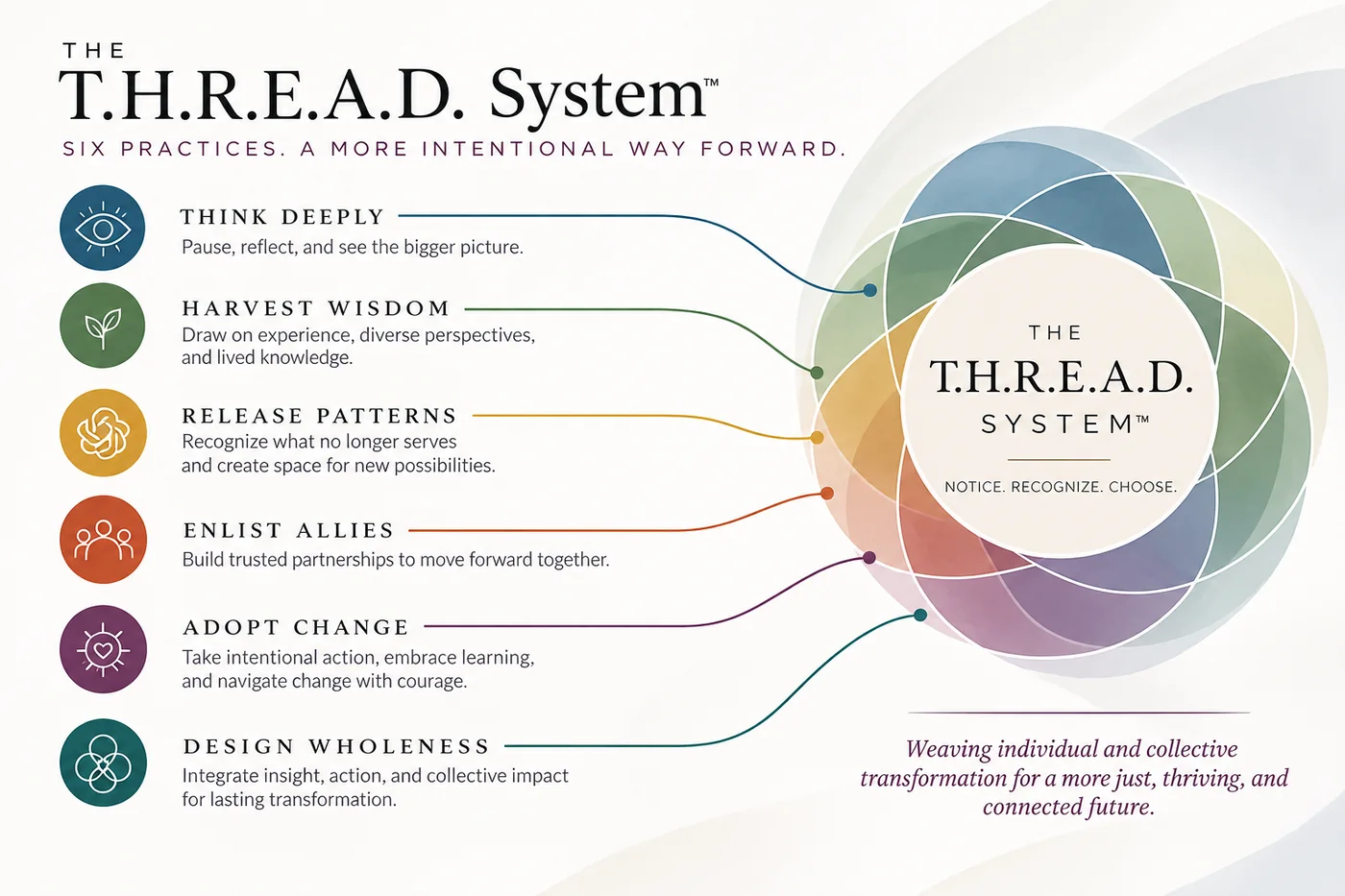
 Think Deeply
 Harvest Wisdom
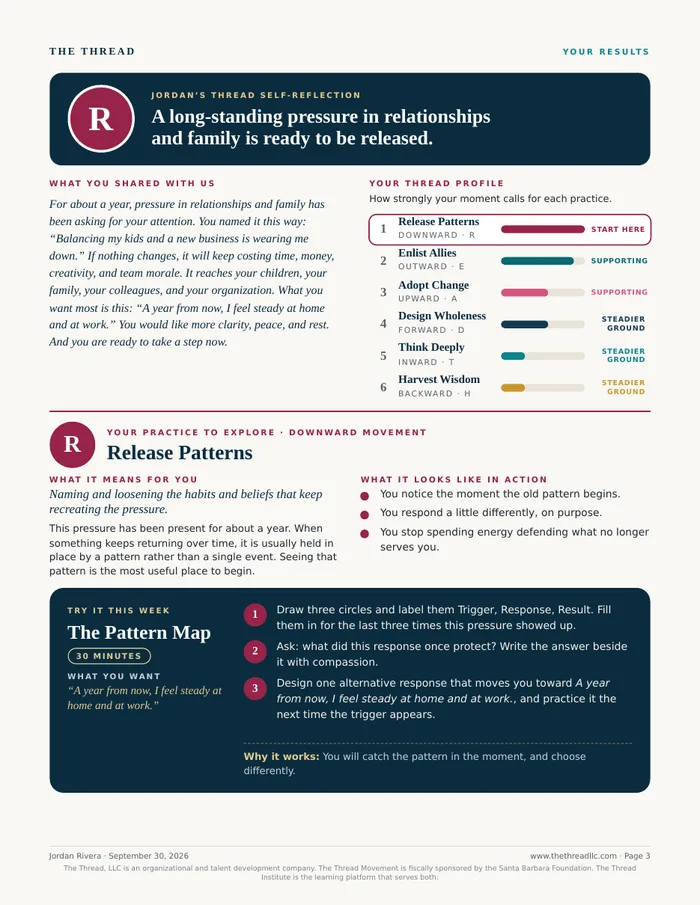
 Release Patterns
 Enlist Allies
 Adopt Change
 Design Wholeness